
October 04, 2026
Are plugs safe? This is how you check before connecting to electricity
Are plugs safe to buy online? A short guide to checking the standard, compatibility with the socket, power, grounding and quality before ordering an adapter, splitter or charger for the home - to save without endangering your home.
A small adapter, a splitter with a switch or a cheap charger can seem like a simple bargain buy. But when it comes to electricity, the question Are plugs safe More important than the discount percentage. A product that is not suitable for the electrical grid in Israel, is made of weak materials or lacks basic protections may heat up, damage the device, and in extreme cases also create a risk of electric shock or fire.
The good news is that you don't have to be an electrician to filter out problematic products. A few short checks before ordering, and another check when the package arrives, will help you identify an adapter, plug or splitter that is worth buying - and a product that is better left on the sale page.
Why do cheap plugs require additional testing?
A plug is not just a piece of plastic with two pins. It connects a powerful power source and a home appliance, so the quality of the contacts, the thickness of the wires, the insulation and the internal protections determine much more than the external design.
In particularly cheap products, sometimes the savings come from parts you don't see: thin metal in the contacts, plastic that tends to heat up, loose internal connections or a cable that doesn't fit the declared load. Even a five-star rating is not sufficient proof of safety. It is a useful sign, especially if there are many orders and reviews with pictures, but it does not replace a clear specification.
There is also a difference between a simple adapter, which only changes the shape of the pins, and a voltage converter or charger. An adapter does not change the voltage. Therefore, a device that is only designed for 110 volts may be damaged if you connect it using only an adapter to an Israeli outlet of 230 volts.
Are plugs safe in Israel? Start with the right fit
The electrical grid in Israel usually operates at a voltage of 230 volts and a frequency of 50 Hz. Before each order, look for the entry range on the product, charger or power supply. A wording such as `100-240V, 50/60Hz' usually indicates that it corresponds to the voltage in Israel. If it says `110V only' or `120V only', don't assume a pin adapter will solve the problem.
The shape of the plug is also important. Outlets in Israel usually accept an Israeli plug, and sometimes European two-pin plugs are also suitable. American, British, Australian and other types of plugs will require a suitable adapter. The physical fit is not a cosmetic issue: a plug that does not sit well in the socket can create unstable contact, heat and small sparks.
In devices with high power consumption, such as a kettle, small oven, heat diffuser, hair dryer or coffee machine, you should not rely on a cheap universal adapter. These are products that require precise power adjustment, proper grounding and high quality construction. Conversely, a quality travel adapter for a phone or laptop charger may be a reasonable solution, as long as the power rating is appropriate.
Plug, adapter, splitter and converter - not the same thing
It is easy to get confused between the terms, and this is exactly where buying mistakes happen. A plug is the part that goes into the socket. An adapter changes the type of physical connection. A splitter allows you to connect several devices to one outlet. A voltage converter changes the electrical voltage, and a charger converts the electricity to the appropriate voltage for the device.
If you order a product with USB sockets, also check the total power and not just the number of connections. A splitter that offers six ports, for example, cannot necessarily charge six devices at full speed. Look for a clear figure in watts or amperes, and not just a general promise of "fast charging".
The signs to look for on the product page
A good product page gives simple answers: what voltage is the product suitable for, what is the maximum current, what is the maximum power, is there grounding and what protection mechanisms are there. When these details are completely missing, it's a good reason to move on to the next product - even if the price is tempting.
In adapters, splitters and chargers, look for specifications that indicate overload, overheating, short circuit and overvoltage protection. The protections do not guarantee that a product will never break, but they reduce the risk when something does go wrong.
Also pay attention to the correctness marking and conformity statements. Marking alone is not a guarantee of quality, because symbols can be printed even without sufficient control. However, a product that displays an identified manufacturer, consistent specifications, instructions for use, and complete electrical information is significantly better than an anonymous product with only a brief description and general images.
If it is an electrical product that is imported for permanent use in Israel, you should also check the relevant standardization and import requirements before purchasing. A small travel adapter and a home heating device are not at the same level of risk, so the level of testing should also be different.
Adjusting the power: the point that should not be skipped
Power is measured in watts. The more electricity the device consumes, the more the connecting device must be able to carry a higher load. Do not choose a splitter based on the number of outlets only. Check its maximum power and compare it to the expected consumption of everything that will be connected to it.
Chargers, lamps, routers and televisions generally consume less than heating devices. But combining several devices on the same splitter can add up quickly. A kettle, toaster oven, heat spreader and iron on one splitter is a combination that should be avoided, even if each of them works separately.
In charging products, a higher power adjustment is not necessarily dangerous, as long as it is a normal charger and the charging device supports it. The phone or computer should pull only what it needs. The risk increases when the charger itself is of poor quality, the cable is damaged or the specification is unreliable.
Grounding is not an addition - it is a layer of protection
Some devices use grounding to reduce the risk in the event of an internal fault. If the appliance has a grounded plug, don't use an adapter that ungrounds just to plug it into an outlet. The same rule applies to splitters: a socket that looks suitable from the outside, but does not actually include grounding, is not a good choice for devices that require it.
Especially in the kitchen, bathroom, balcony or near water, there is no room for improvisation. Moisture, strained cables and loose adapters are a problematic combination. Only use products that are intended for the appropriate environment, and keep the outlets dry and accessible.
When the product arrives: a minute test before use
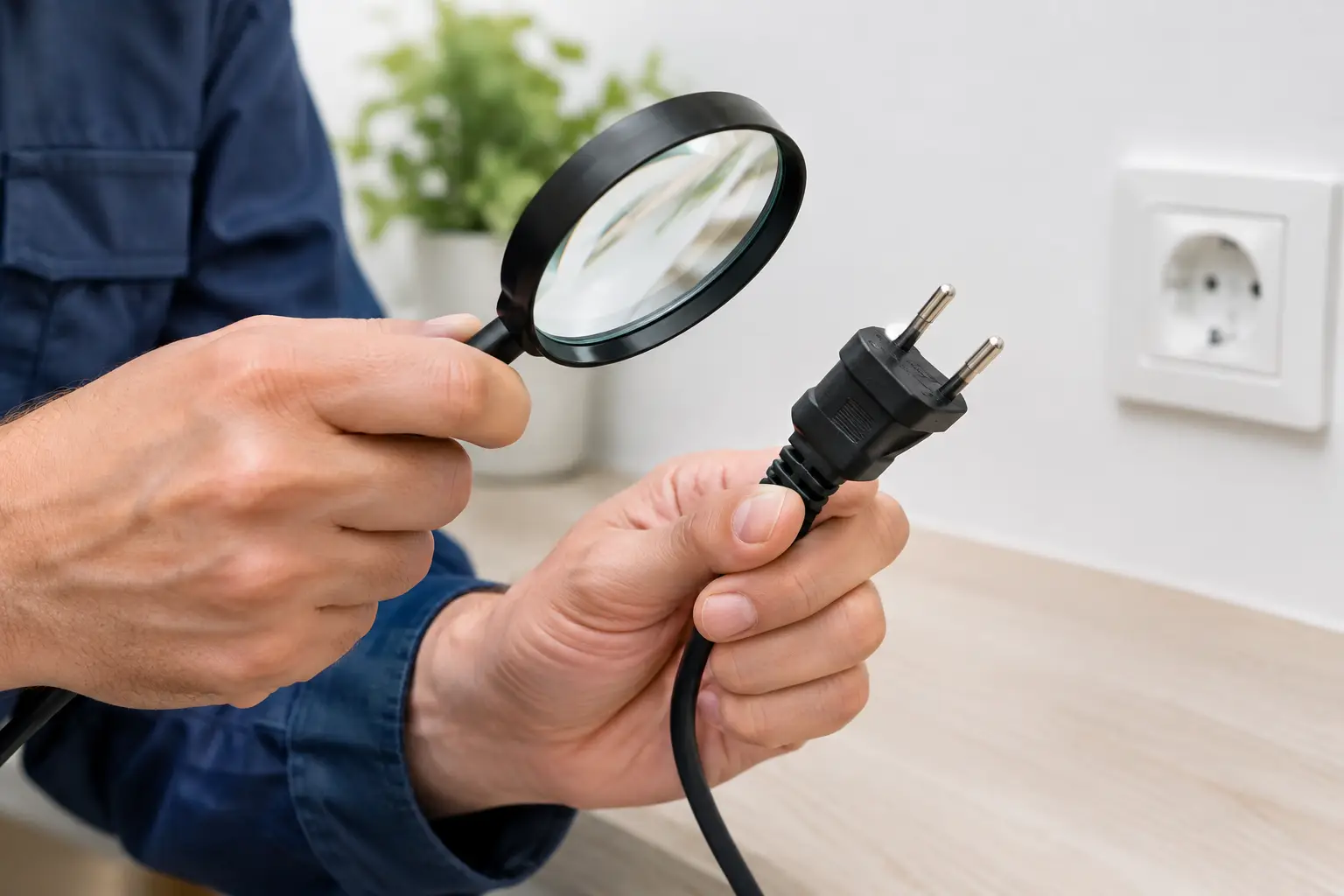
Even a product with good specifications needs to undergo a brief inspection by hand. Look at the body of the product, the pins and the cable. Cracked plastic, bent pins, a pungent chemical smell, a cable that is too thin or loose parts are red flags. Do not try to "fix" a crooked plug or open an electrical product by yourself.
For the first connection, it is better to start with a low-power device and stick around. If the plug, adapter or outlet heats up noticeably, if there is a burnt smell, unusual noise, flickering or a loose connection - immediately unplug the device and stop using it.
Do not cover chargers and splitters with clothing, blankets or carpets. They need heat dissipation. Also, don't chain splitters to each other. This is an easy way to load on one power point without paying attention to the total consumption.
How to buy smart without paying too much
Low price is not the problem. The problem is buying without knowing what you are getting. In the reality of changing deals, you can find adapters and chargers at a good price even from sellers who display detailed specifications, a long order history and useful reviews.
Before you add to the basket, compare two or three products according to the safety data and not only according to the price: input voltage, maximum power, grounding, protections, socket type, user rating and the number of orders. A small difference in price can be worth a lot if it buys you a thicker cable, a true match for local electricity and an identifiable manufacturer.
On deal sites like Smart Home Finds Deals, filters, categories and ratings can shorten the initial search. And yet, the responsibility to check the electrical specifications of the exact model remains with the buyer - especially when it comes to a product that connects directly to an outlet.
The smart choice is not always the cheapest product, but the product that gives clear information and is exactly suitable for your use. When there is doubt about a plug, voltage, power or grounding, it is better to give up one deal than to bring home an unnecessary risk.