
July 28, 2026
How to choose compact kitchen accessories without wasting space
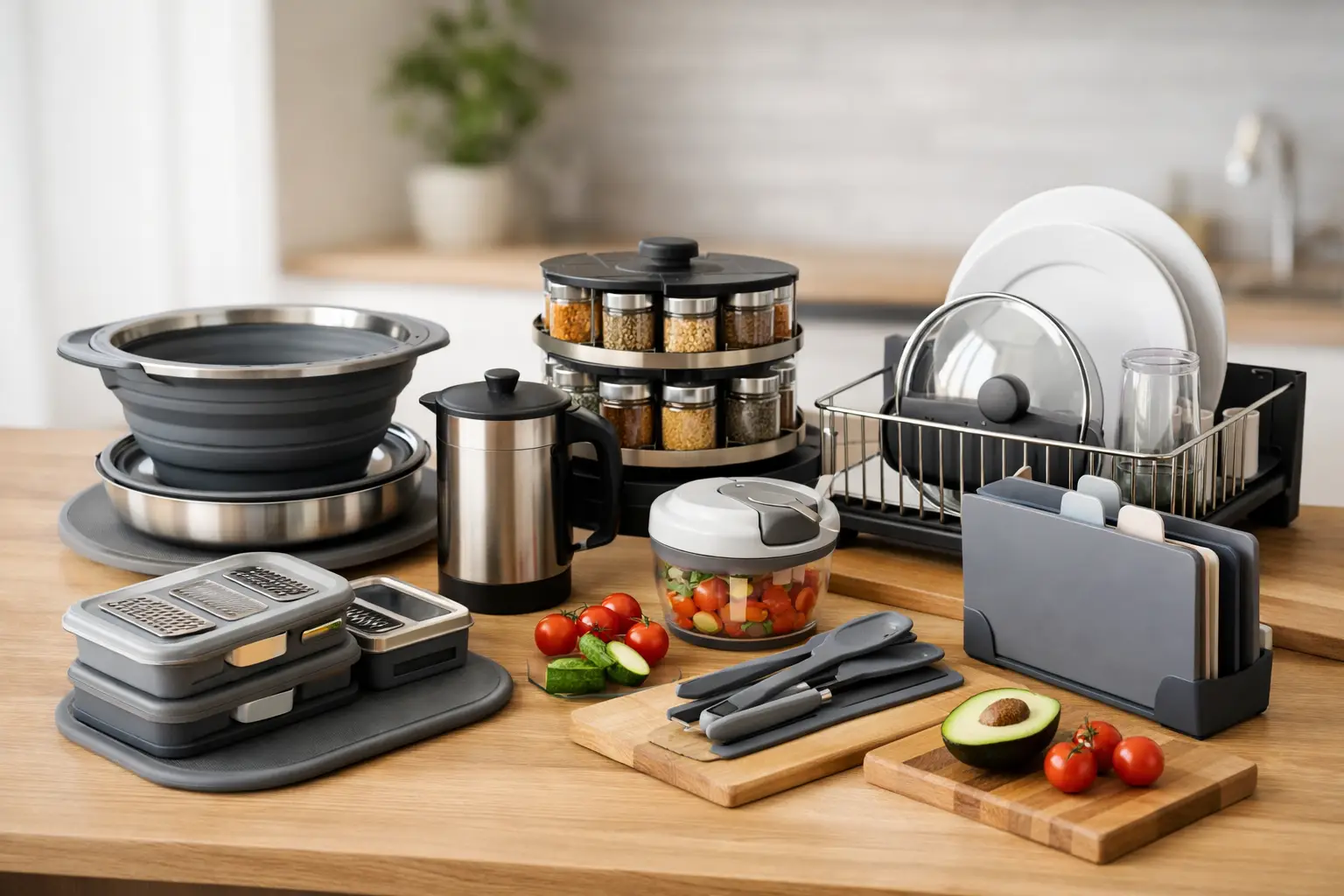
How to choose compact kitchen accessories that really fit your place: check dimensions, daily use, quality, cleaning, ratings and price before adding to cart, and save money with every order.
A shelf full of small gadgets can seem like a smart solution, until you find that the drawer no longer closes and that two tools do exactly the same job. The question of how to choose compact kitchen accessories is not only a matter of a small product or a low price. It's about choosing items that save space, shorten daily operations and justify the space they occupy at home.
A good compact accessory doesn't have to be tiny. It should provide high value in relation to its volume: work well, be convenient to store, clean easily and adapt to your cooking habits. Before looking at the discount percentage, you should understand what is really missing in the kitchen.
Start with the problem, not the product
It's easy to be tempted by a small chopper, a folding mandolin or a silicone utensil that looks useful in a picture. But a good purchase starts with a simple question: What action in the kitchen is holding you back again and again? If cutting vegetables for quick meals is time-consuming, a quality manual chopper may come in handy. If the work surface is small, a folding cutting board with an opening for transferring food can help more than another bowl.
Try to think about the last week, not about the dream kitchen. Do you prepare meals for two, host often, use lunch boxes for work or cook mostly on weekends? A product intended for large portions may be unnecessary in a small apartment, while a strainer attached to a pot or a thin digital scale can become tools that are used almost daily.
You should also check if there is a solution that you already have. A multipurpose accessory is only worthwhile when it actually replaces two or three existing items. A tool that promises ten actions but performs each of them mediocrely may be left behind in the drawer.
How to choose compact kitchen accessories according to real measurements
The word "compact" in the ad is not a product size. Check the length, width and height when the product is open and also when it is folded or stored. If it is a dish that sits on the counter, measure the free space next to the sink or stove. If it is intended for a drawer, also check the height of the drawer and the space required for opening.
There is a big difference between a product that can be placed in a drawer and a product that can be pulled out without dismantling half the kitchen. For example, a set of stackable measuring cups fits a shallow drawer, but handles that are too long can make organizing difficult. A flat peeler or a firecracker with a folding handle saves volume, but only if the folding mechanism does not open by itself during storage.
Also pay attention to the space the product requires during use. A small citrus juicer can be perfect for storage, but if it slides on the work surface or requires a lot of force, saving space comes at the expense of convenience. Small dimensions are an advantage only when they do not make the operation cumbersome.
Check the four indicators before adding to the cart
- Degree of storage: How much space the product takes up when closed, disassembled or stacked.
- Degree of work: How much space is needed to use it comfortably and safely.
- Capacity: Is it suitable for the amount of food you actually prepare?
- weight: Is it easy to pull out, hold and clean, or is it too heavy for frequent use.
The capacity is especially important. A collapsible mixing bowl is an excellent solution for a small kitchen, but a bowl with too small a volume will require you to work in several rounds. In such a case, a slightly larger vessel that meets the need at one time may be the more economical choice.
Prefer usability over the number of functions
Multipurpose kitchen accessories seem worthwhile, especially when the sale price is low. Sometimes they are indeed a good choice: an opener that combines a bottle opener, a can opener and a small screwdriver can save space. But when it comes to cutting, baking or measuring tools, multiple functions can compromise accuracy and convenience.
The simple rule is to check whether you will use at least both functions regularly. If so, an integrated product makes sense. If you only need one operation, choose a dedicated and simple tool. A good peeler, for example, will often beat a five-blade combination tool that is difficult to clean and put back into place.
In a small kitchen, flat, stackable, folding or hanging products are usually the right choice. A flexible silicone lid, a strainer that opens above the sink, a thin defrosting surface or a lid holder for the cabinet door can free up space without adding visual clutter. On the other hand, a gadget with a special shape that cannot be stacked or hung may create a new storage problem.
The quality of the material determines whether it is a good deal
A low price is not necessarily a savings if the accessory breaks after a few uses. In products that touch food or heat, check the raw material and the description of use. High-quality silicone is suitable for flexible utensils, baking spoons and lids, but it is important to make sure that it is intended for contact with food and that it has clear heat resistance. Stainless steel is suitable for strainers, peelers and graters, especially if it is thick enough and does not have sharp edges or loose joints.
In plastic products, look for a stable structure and not just an attractive color. storage boxes, collapsible funnels or spice racks should feel stiff at the pressure points. If there are hinges, springs or removable parts, these are the first places to wear out.
Dishwasher compatibility is an advantage, but it is not always enough. Ask yourself if it is possible to reach all the grooves with a sponge. Clippers with sharp blades and a small chamber may save time in cutting, but waste it in cleaning. In products of this type, a simple design is sometimes better than a sophisticated mechanism.
This is how to read ratings and reviews in a smart way
A high rating is a positive sign, but you should see the whole picture. A product with a good score and a significant number of orders usually gives a better indication than a new product with a few individual reviews. Focus on reviews that mention actual use: is the tool sturdy, does the size match the description, does it open and close easily, and does it remain in good condition after cleaning.
Buyer photos are especially helpful in compact accessories. A studio photo can make a tool look bigger or better quality than it is. A picture next to a hand, pot or drawer gives a real sense of scale. If a number of buyers mention that the product is smaller than expected, don't assume that this is necessarily a disadvantage - maybe this is just the right size for your kitchen. Just make sure the capacity doesn't surprise you.
You should be wary of general reviews like "perfect" or "beautiful" without detail. Look for comments on the material, packaging, mechanism and durability. Even a negative review is not an immediate reason to give up: if it complains about a feature that is not relevant to you, it is less important. If she repeats again and again a fracture, a pungent smell or misleading measurements, it is better to switch to another product.
Set a target price instead of chasing a discount
A high discount percentage is eye-catching, but it is not the only indicator of a good deal. Compare similar products by material, capacity, rating and number of orders. Sometimes a slightly more expensive accessory, with better construction and consistent reviews, will save you a repeat purchase in a few months.
It is recommended to set a small budget for each type of product. For a simple tool like an egg separator or a bag clip, the price should be very low and the expectations accordingly. For a tool you will use often, such as a kitchen scale, a vegetable chopper or a set of stackable boxes, it is worth paying a little more if the data points to quality. Don't add several small items to the cart just because each one is cheap - together they can cost more than one tool that really solves a problem.
Build a small kitchen that works faster
The most cost-effective accessories are usually those that reduce friction in operations that repeat every day: storage, cutting, measuring, filtering and cleaning. Choose one or two items at a time, use them for two weeks, and only then decide what is missing. This way you will avoid a drawer full of deals and build a collection of tools that really fits your lifestyle.
Before the next purchase, open the drawer where the product is intended to go. If you already know exactly where it will sit, what it will replace and in which meal you will use it for the first time, there is a good chance that you have found a small accessory with great value.