
August 19, 2026
How to choose car charging accessories without paying too much
How to choose car charging accessories? Check outlet compatibility, true power, safety standards and number of outlets, and compare ratings and orders to find a useful deal at the right price. And affordable delivery
The phone is on 8%, the navigation is on, and you are on your way to a meeting or to pick up from kindergarten - this is exactly the moment when a cheap and unsuitable car charger becomes a frustrating purchase. the question How to choose car charging accessories It does not come down to the color or the price: you have to match the vehicle socket, the device, the charging speed and the quality of the product. A correct choice allows you to charge quickly, save the battery and prevent a situation where the cable disconnects from every teacher.
First define what really needs to be claimed
Most drivers are looking for a phone solution, but not every use is similar. A driver who uses navigation for hours needs a charger that provides stable power even when the screen is on, the GPS is active and the phone heats up. A family, on the other hand, may need at least two ports - one for the driver and one for the rear passenger, or for the children's tablet.
Start with three simple questions: which devices will be charged in the car, how many of them at the same time, and whether fast charging is required. If your phone supports USB-C, look for a suitable USB-C charger and cable. If you're using an iPhone with a Lightning connection, make sure the appropriate cable is included or planned to be purchased separately. A great charger without the right cable won't solve any problem.
It is important to separate phone charging accessories from electric vehicle charging. A charger that connects to the cigarette lighter socket is not a solution for charging the drive battery of an electric vehicle. EV charging has completely different standards, suppliers and safety connections, so you need to choose dedicated equipment according to the vehicle and the electrical infrastructure.
Check the type of outlet before checking the price
Most cars have a 12V socket, sometimes referred to as a cigarette lighter socket. A quality charging adapter goes into it and provides USB ports. Newer vehicles may already have built-in USB-A or USB-C ports, but they are not always fast enough. If the built-in port is just maintaining the battery percentage while navigating, a 12V adapter with fast charging can be a very useful upgrade.
Also pay attention to the location of the outlet. When the socket is close to the gear lever, a particularly prominent charge may interfere. In such a case, a compact model or a low-angle adapter is preferable. If the outlet is in the boot or rear, a longer cable may be the practical solution - but not too long to get tangled around seats and handles.
Charging power: the number to understand
The power is measured in watts, and it affects the possible charging speed. A basic 10W or 12W charger may be enough for calls, music and short trips. For prolonged navigation or fast charging of a modern smartphone, you should look for a USB-C port with a power of 20W or more.
But the big number in the title doesn't always tell the whole story. A charger advertised as 40W with two ports can divide the power between them. That is, when two devices are connected, each of them may receive less than the guaranteed speed. Check the description for how the power is distributed between the ports, especially if you charge two phones together.
USB-C PD, QC and what it means in practice
PD, or Power Delivery, is a common standard for fast charging via USB-C and is suitable for many devices, including new phones and sometimes tablets. QC, or Quick Charge, is common on some Android devices. A charger that supports two devices gives better flexibility at home with different types of devices.
However, there is no point in paying a high surcharge for 65W if you are only charging a phone that supports 20W. Adjust the power to the device and use. Those who also charge a tablet, portable game console or small computer with USB-C can benefit from a more powerful charger, provided the vehicle and the cable support it.
The cable is part of the charging, not a marginal addition
A weak cable can limit charging even if the adapter itself is of high quality. A very cheap USB-C cable may not support the necessary power, heat up or wear out quickly near the gearbox. Look for a cable with a clear indication of fast charging support and the appropriate power.
A length of one meter is usually comfortable for front travel. A 1.5 to 2 meter cable may be suitable for rear passengers or a further outlet. A spiral cable can keep order in a small vehicle, while a braided cable may be more durable for everyday use. There is no one right answer here: the good cable is the one that reaches the device without stretching, leaning on pedals or creating a permanent mess.
Wireless car charger: convenient, but not always the fastest choice
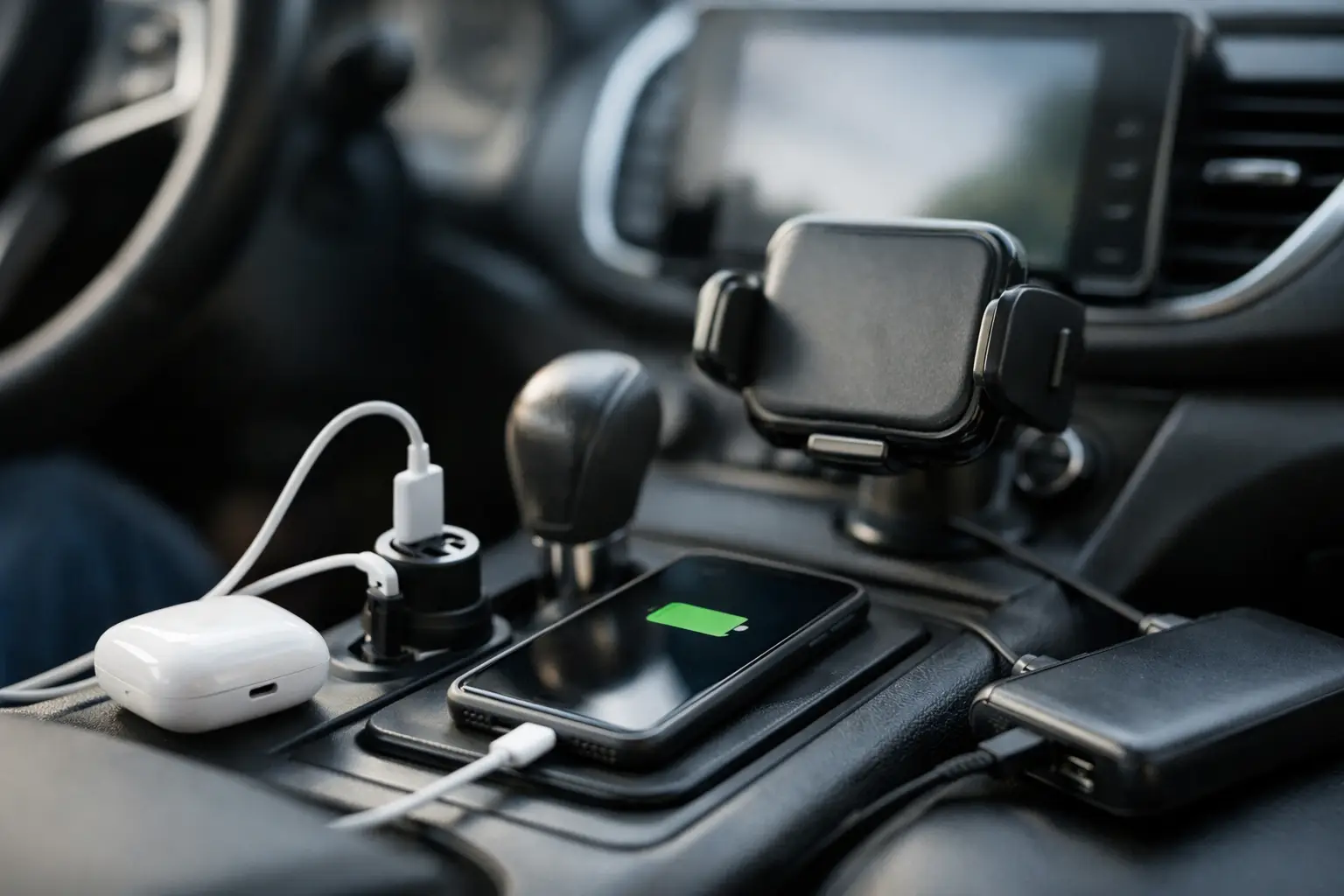
A stand with wireless charging is suitable for those who activate navigation every time they travel and want to place the phone in a fixed place. It reduces fiddling with cables and allows you to keep the screen at a comfortable height. Check that the stand fits the size of the phone even with a cover, and that the connection to the air conditioner vent, dashboard or windshield is stable.
The trade-off is speed and heat. Wireless charging is often slower than wired charging, and on a hot drive with active navigation the phone may heat up. If the goal is to fill a battery quickly, a USB-C charger and a quality cable will usually be a more efficient choice. A good option is a stable stand next to wired charging, especially on long trips.
This is how a product is tested before adding to the basket
In busy catalogs it's easy to be tempted by a high percentage discount, but the lowest price is not necessarily the best deal. Before purchasing, go through the data that reveals if it is a useful product and not just an attractive ad:
- Make sure there is a clear specification of ports, total power and power per port.
- Look for a consistent rating and a significant number of orders, not just a single review with a pretty picture.
- Read recent reviews and see if buyers mention heating, disconnections, or difficulty fitting the outlet.
- Check what is included in the package. Sometimes the low price is for the adapter only, without cable.
- Compare the final price, including shipping, against a similar model with more proven data.
Customer photos are especially helpful in car chargers. They show if the product protrudes from the outlet, if its lighting is too strong at night, and if the cable really looks as durable as in the product photos. Rating, order quantity and full specification are the three fastest buying filters when looking for a good deal.
Do not give up safety for a few shekels
A proper charger should protect against overheating, short circuit, overload and high voltage. Look for clear mention of protection mechanisms and relevant compliance standards, not just general wording like "premium quality." A metal body can help dissipate heat, but quality plastic can also be a good choice if the specs and reviews are reliable.
During the first use, touch the charger after a few minutes of charging. A slight heat may be reasonable, but a very hot charger, a burnt smell, interrupted charging or noises from the socket are signs to stop using it. A cracked cable or loose connector also belongs in the trash, not for the next trip.
When should you choose a charger with two or more ports?
Two ports are usually a good starting point: one on USB-C for fast charging and one on USB-A or additional USB-C for flexibility. For a single driver who only charges a phone, a compact charger with one quality port can be enough and save space. For family or work trips, a model with two or three ports will avoid arguments about the battery.
Remember that a large number of ports does not guarantee fast charging for everyone. Prefer a model that shows a clear power distribution. For example, a charger that provides 30W on the USB-C port even when another port is connected will be more useful than a multi-port charger with ambiguous data.
How to choose car charging accessories according to the type of trip
For short city trips, a 20W charger and a short, reliable cable usually do the job. For intercity trips with navigation, you should choose PD support, a durable cable and a stand that holds the phone without blocking the field of vision. In a family car, prefer at least two ports and a total power that is suitable for two active devices.
If the vehicle stays in the sun for hours, avoid leaving portable batteries and wireless chargers on the dashboard. Extreme heat shortens battery life and can impair performance. Those who travel a lot can also consider a small cable organizer, so that charging is available without the vehicle looking like an open drawer.
A good charging accessory doesn't have to be the most expensive. When the socket fits, the power is real, the cable is right and the reviews support the specifications, you can find a small product that makes every trip easier - and prevents the familiar search for battery percentages just when you need to leave.