November 03, 2026
Smart garden accessories: what is really worth buying?
Looking for smart garden accessories at an affordable price? This is how you will choose irrigation, lighting and useful sensors according to the area of the garden, the budget and the ratings of real buyers before ordering for daily use.
Forgotten watering on a hot day, low lighting near the entrance or pots that look great until you leave for the weekend - these are exactly the places where smart garden accessories can save time, water and frustration. No need to turn the yard into a complex and expensive system. In most homes, a few of the right small products improve maintenance far more than just another garden ornament.
The key is to buy according to a real problem and not according to a gadget that looks impressive in a picture. A moisture sensor won't help if you don't have a way to change the watering, and a solar security camera won't be a good choice in a shaded area. Before ordering, you should understand what the product does, where it is supposed to work, and what buyers who have already installed it say.
Which smart garden accessories give the best value?
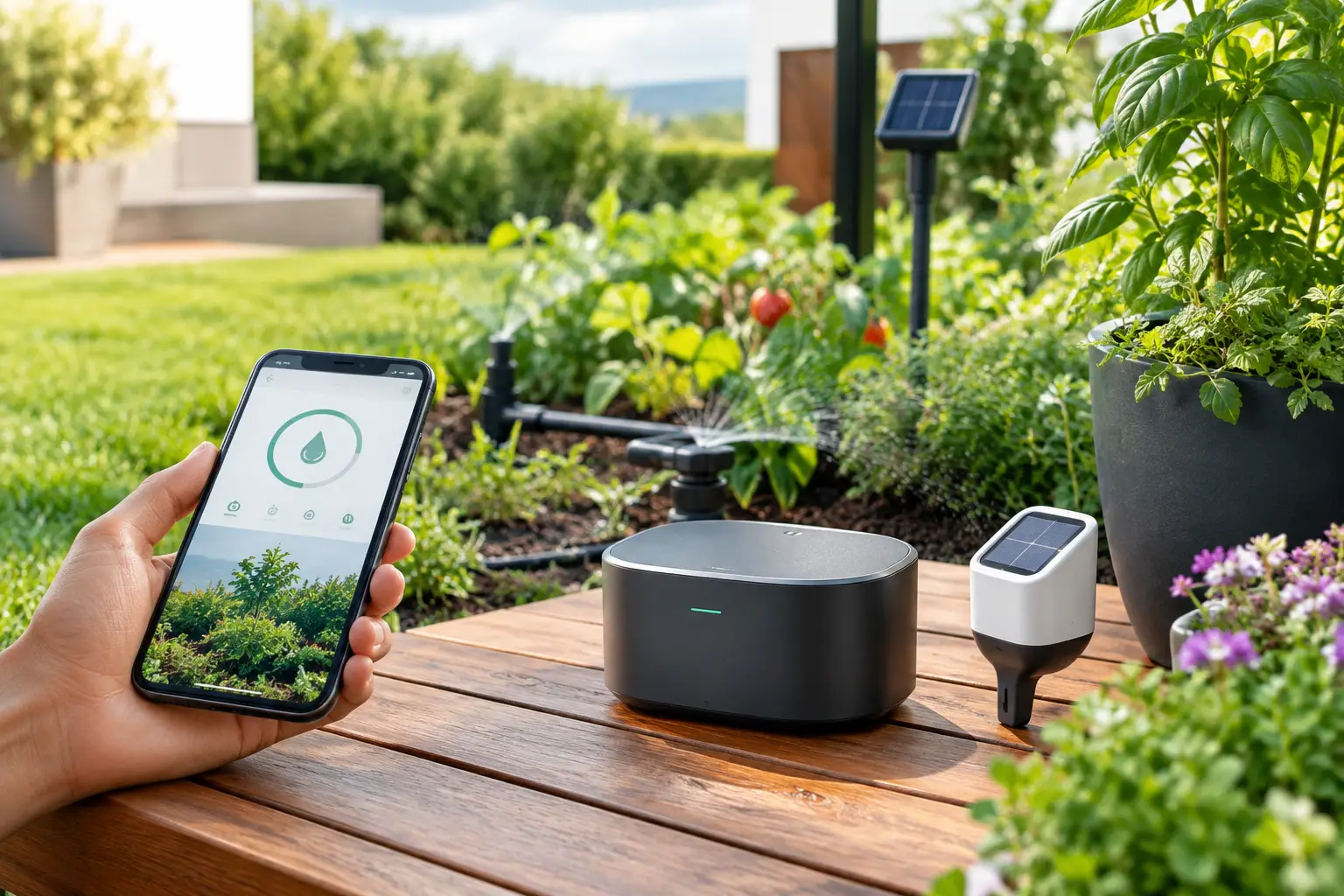
For most gardens and balconies, the worthwhile investment begins with irrigation. A digital irrigation controller that connects to the faucet allows you to set days, hours and duration of irrigation without standing next to the hose. Simple models operate according to a fixed schedule, while more advanced models allow control from the phone and sometimes also adjustment to the weather forecast. If the garden is small and the need is constant, basic cattle will usually be enough and will cost less.
Soil moisture sensors are a good addition for those who grow beds, pots or vegetables. They measure the condition of the soil and show whether it is dry, moist or saturated. It is important to distinguish between a hygrometer with a local display and a sensor that connects to an app: the first is cheaper and simpler, and the second is convenient for remote monitoring but requires a battery, a connection, and sometimes a compatible hub.
Solar lighting with a motion sensor can also be a very useful purchase. It is especially suitable for a path, a warehouse, a gate or a dark corner near the entrance. It does not necessarily replace professional outdoor lighting, but provides a quick solution without drilling and without calling an electrician. Check that the solar panel gets enough direct sunlight during the day.
There are also products that add convenience and not just maintenance: smart temperature gauges, outdoor sockets with timers, weatherproof cameras and automatic water sprinklers. They can be great, but you should buy them only after the irrigation and basic access to the garden is already arranged.
Start from the problem, not the operation
A low price is a good reason to check out a product, not a sufficient reason to order it. Ask yourself what is holding you back today: are the flower pots drying out while you are at work? Are you watering too much? Is it hard to see the trail at night? An obvious answer quickly narrows down the relevant product category.
If the problem is inconsistent watering, look for a controller or drippers with a timer. If you don't know when to water, a moisture meter or soil sensor would be a good starting point. If the goal is safety and comfort in the evening, solar traffic lighting is generally preferable to purely decorative lighting fixtures.
In a rented garden or on a balcony, mobile solutions that do not require a permanent infrastructure are preferable. In a large garden with several watering areas, a cheap product that handles only one faucet can quickly become a limitation. In that case, it is better to pay a little more for a controller with several ports or choose a system that can be expanded later.
How to check a product before ordering
In busy catalogs it is easy to focus on the main image and the discount percentage. In garden accessories, it is the small specifications that determine if the product really fits. Go through four details before buying:
- Adaptation to outdoor conditions: look for an explicit mark of resistance to water, dust and sun. A product intended for the face will not last next to a sprinkler or under a strong summer sun.
- Power source: Check if the product works on batteries, solar charging, electrical connection or water tap. Batteries are convenient to install, but require replacement over time.
- Connections and dimensions: In irrigation controllers and pipes, the diameter of the threads and adapters are more important than the design. Measure the existing connection before ordering.
- Ratings and orders: A high score is helpful, but you should also read reviews with pictures and see how many orders the product has already accumulated. This makes it easier to identify a gap between a marketing description and real use.
Especially in products that connect to the application, check if the application is available in a language that is convenient for you and if the connectivity is suitable for the home network. Some devices only work at a certain frequency, and some require a separate hub that is not always included in the package. A cheap product becomes less profitable if you have to buy more parts around it.
Smart irrigation: the savings depend on the installation
A smart irrigation system sounds like an automatic solution for saving water, but it will only save if the settings are correct. A timer that runs watering too long still wastes water. A sensor placed too close to the dripper may report that the soil is moist while the other plant roots are already dry.
You should start with a conservative plan and check the condition of the soil after a few days. The type of soil also matters: sandy soil dries quickly, and heavy soil holds moisture longer. Small pots heat up and dry out faster than a shaded flower bed, so it is not always right to run the whole garden in the same plan.
Those who travel often can derive real value from remote control, provided there is stable reception in the area of the controller. On the other hand, if you are at home most of the time and watering is simple, a basic mechanical or digital timer will be reliable, easy to operate and sometimes more durable over time.
Lighting, security and comfort in the outdoor area
Smart garden lighting does not have to be colored or connected to a smart home system. Sometimes a motion sensor is the most practical solution: it lights up when you enter the yard, deters unwanted guests and prevents searching for keys in the dark. Look for a wide lighting angle and an adjustable operating time, so that the light does not turn on from every small movement on the street.
With outdoor cameras, image quality is only part of the story. Check shooting angle, night vision, storage method and whether registration for a paid service is required. A solar camera can save electricity connection, but it depends on the number of hours of sunshine and the location of the panel. If it is installed under a pergola or a dense tree, solar charging will not be a real advantage.
Outdoor sockets with a timer are suitable for turning on lighting, a small pump or seasonal decorations at fixed hours. Here too, make sure that the outlet is designed for external use and that the permitted electrical load matches the device you are connecting to. Do not plug in a powerful product just because the plug fits into the socket.
Mistakes that waste money
The most common mistake is to buy a large system before understanding the area of the garden. Excess sensors, cameras and lighting does not necessarily give more control - it can add batteries, alerts and maintenance. Start with one product that addresses the biggest problem, then expand only if it really helps.
Another mistake is to ignore the installation. A product that arrives with unclear instructions or without appropriate adapters may remain in the box. Go over what's included in the package, and check the review photos to see if other buyers note missing parts, leaks, or connection issues.
The price should also be considered in context. A deep discount on a product with few orders is not necessarily a better deal than a slightly expensive product with a solid rating, lots of reviews and user photos. On platforms that centralize products, discounts, ratings and order quantity, you can filter the options more quickly and check what seems really worthwhile before moving on to the product details.
A short shopping list for a more efficient garden
For those who want to upgrade without overloading, the order of purchase is usually simple: first an irrigation controller or timer, then a hygrometer if it is difficult to know when to water, then traffic lights for transit areas. Only after the base works, should you consider a camera, smart socket or additional sensors.
Good smart garden accessories shouldn't make you check your phone anymore. They should reduce the number of times you remember the garden only when something has already dried up, burned or stopped working. Choose a product that fits your habits, check the specifications and reviews, and let the garden prove if the upgrade is really worth the place and the price.