
October 28, 2026
Smart home security: what is worth buying for the home
Home security on a smart budget: this is how you choose a camera, sensors and lighting that add control and deterrence without burdening the home, the installation or the shopping basket. With selection according to need, rating and current price.
The package that arrives at the door, the back door that you don't always remember to lock, or the dog that is left alone for a few hours - these are usually the moments when you think about home security. You don't have to turn your house into a fortress, nor buy an expensive system with dozens of components. The goal is to get a useful alert, see what's happening when needed, and create a basic deterrent at a price that fits your home and routine.
For most houses, the right purchase starts with a simple question: what situation do you want to solve? Those who want to check who is ringing the doorbell need a different product than those who want to receive a notification when a window is opened. When you define the need before starting to compare offers, it is easier to find small and useful products instead of filling the shopping basket with gadgets that will never be installed.
Home security starts with the important points
Before choosing a camera or sensor, take a moment to review the entrances to your home and your habits. A front door, balcony door, accessible window, parking lot, storage room and interior hallway are the places where a small security product may give the greatest value. In a rented apartment, for example, wireless solutions and gluing without drilling can be better than a fixed system, even if they are less advanced.
An indoor camera is suitable for monitoring pets, children returning from school or activities at home while away. An outdoor camera is more suitable for the entrance, parking or yard, but it should be designed for outdoor conditions and not just be placed near a window. A small opening sensor for a door or window gives a direct notification of opening, and is sometimes more effective than a camera that takes pictures of a wide area without clarifying what exactly happened.
Also think about the action you want to take after receiving the alert. If you just want to know that the door has been opened, a sensor with a message to the phone is enough. If it is important for you to identify a person or check a shipment, a camera with a clear image and night vision would be a better choice. If the goal is to deter, lighting that turns on when motion is detected can complete the image at a relatively low cost.
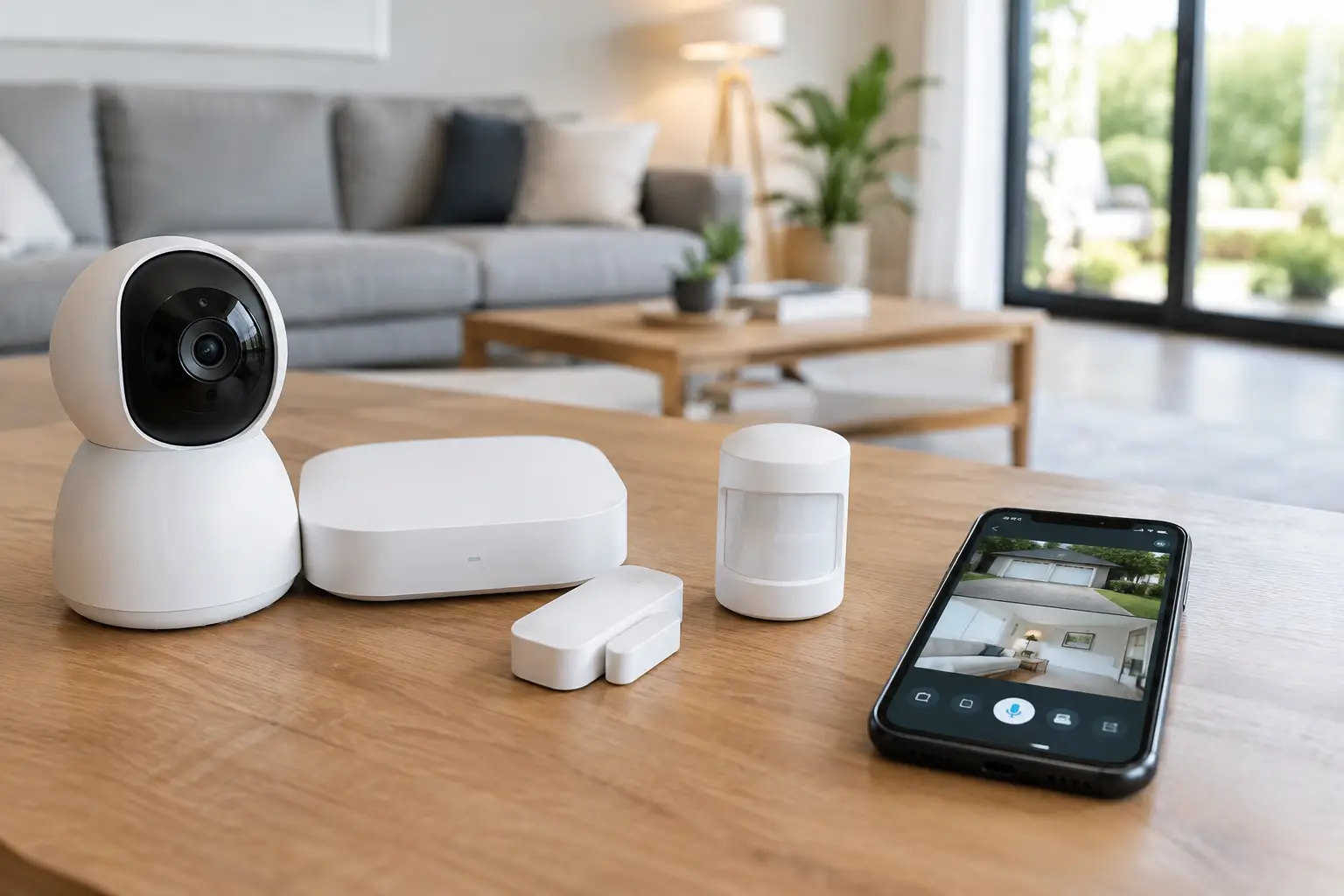
Four products that give useful coverage
Not every home needs all the products, but the following four categories cover most everyday needs:
- Indoor wireless security camera - Suitable for central room, pets and remote inspection. Look for wide-angle photography, night vision, two-way audio, and adjustable motion alerts.
- Outdoor camera - Designed for the entrance, parking or balcony. It is important to check water and dust resistance, quality of photography at night, a stable installation option and a wireless connection that reaches the installation point.
- Door or window opening sensor - A small and cheap product that alerts you as soon as an entry point is opened. It is excellent for a back door, a warehouse or a window that was accidentally left open.
- Lighting with motion sensor - Provides deterrence, comfort and safety when walking at night. It doesn't replace a camera or lock, but can make a dark area look less inviting.
You can even start with just two items: a camera at the entrance and a sensor on the side door, or an internal camera and traffic lights outside. After two weeks of use you will already know if there is a lack of coverage in a certain place. It's a better way to build a system than ordering everything at once because of a big discount.
What to check before buying a security camera
A beautiful product image and a low price are not enough. First of all, check how the camera connects to the home network. Many models work only on a certain frequency of a wireless network, and sometimes the router at home is configured differently. If the camera is intended for outdoors, check in advance that the reception at the installation point is good. A camera that loses connection right next to a gate or warehouse will not provide the security you were looking for.
Photo quality is important, but there's no need to chase the highest number in the specs. For basic door-to-door detection, a sharp and stable shot in low light is more important than a promise of ultra-high resolution. Pay attention to photo examples of buyers, especially in night photography. There, reflections from a window, dark areas and blurred motion are usually detected.
Storage is another decision point. Some cameras save recordings on a memory card, others offer cloud storage, and some support both options. A local memory card may save ongoing payment, but you should check the supported card capacity and the possibility to view the recordings easily. A cloud service can be more convenient, but you should check in advance if it involves a subscription and what is stored free of charge.
Traffic alerts are only useful when they are accurate enough. A camera that alerts you to every shadow, passing car or curtain movement will make you silence it. Preference is given to a model that allows you to determine areas of detection, sensitivity or filtering of small movements. If your entrance faces a busy street, this feature is worth more than another photo mode you won't use.
A low price is a start, not the whole test
Products in the field of home security are sold in a wide price range, and sometimes two models that look almost identical are very different in the experience of use. Check the average rating, but don't settle for it. A high number of orders and reviews with pictures help to understand whether the product really arrived, installed and worked as described. Also read mediocre reviews, not just the most positive ones - there you will find information about a cumbersome app, a short cable, a weak battery or unclear installation instructions.
Correct specification should match the location. A cheap camera with a power cord can be a great deal indoors, but outdoors you'll also need to consider outlet access, rain protection, and cable management. A rechargeable model saves cable, but requires periodic charging. A solar panel can facilitate maintenance in a lighted place, but will not solve the problem of absorption or unstable installation.
Compatibility between products is also not self-evident. If you want to control several devices from one app, make sure before purchasing. Otherwise, there is no problem to buy separate and cheap products - you just might switch between several apps. For those looking for a basic solution, this is often a reasonable price to pay for significant savings.
Proper installation is worth more than another feature
A camera placed too high will shoot mostly heads. A camera that is too low can be easily moved or damaged. At the entrance to the house, try to direct it so that you can see the access area and the face of the approaching person, without photographing the neighbors' private area. Inside the house, it is better to point towards a passage or a door rather than towards a window, to avoid reflections and a burnt image in daylight.
Before gluing or drilling, connect the product to electricity or charge it, install the appropriate application and check reception at the point itself. Turn on motion detection, leave the room and come back in to see if the alert arrives on time. A ten-minute test before installation saves disassembly, reloading and frustration after a few days.
In opening sensors, the two parts should be close and in a suitable line when the door or window is closed. A dirty surface or loose connection can cause false alarms. In traffic lighting, you should aim the sensor at the walking area and not directly at the road, a moving tree or an outdoor air conditioner.
Privacy and digital security at home
A home camera not only watches the house - it is also a device connected to the network. Therefore, choose a unique and strong password for the camera account, replace the default password if it exists, and activate additional verification for the account when possible. Software updates are not an afterthought: they may fix bugs and improve access security.
Avoid placing cameras in bathrooms, dressing rooms or anywhere where guests and household members expect complete privacy. If there is a nanny, cleaner, subtenant or regular guests, it is better to be clear about the existence of the cameras and their location. Good security should not come at the expense of basic trust and respect.
Build gradually, choose according to data
There is no single product that guarantees complete protection, but a simple combination of proper locking, lighting, alerts and a camera in the right place can greatly improve home control. Start with the point that really bothers you, compare price against rating, number of orders and features you'll actually use, then expand only if necessary.
In organized catalogs like Smart Home Finds Deals it is easy to filter products by category, price and trust marks instead of searching through hundreds of similar results. The best deal isn't always the cheapest camera - it's the product you can install today, understand in minutes, and continue to use in a month.