
November 01, 2026
A smart plug versus a mechanical timer: what is worthwhile for your home?
Smart plug vs. mechanical timer: a simple comparison of cost, convenience, timing and remote control to choose an affordable solution for lamps, heaters, fans and household appliances that are common in the home as well.
A smart plug versus a mechanical timer is not just a matter of a new gadget versus an old solution. It's a choice between a cheap product that performs a fixed action, and a more flexible way to control the devices through the phone, automations and sometimes also voice commands. If your goal is to turn on a lamp at a fixed time, a mechanical timer can certainly suffice. If you want to know what's working at home when you're away, change a schedule without getting up from the couch or save electricity more precisely, a smart plug is worth checking out.
Both have a place in the home, especially when looking for useful upgrades at a low price. The good decision depends on the device you connect, your habits and how much control you really need.
What is the actual difference between a smart plug and a mechanical timer?
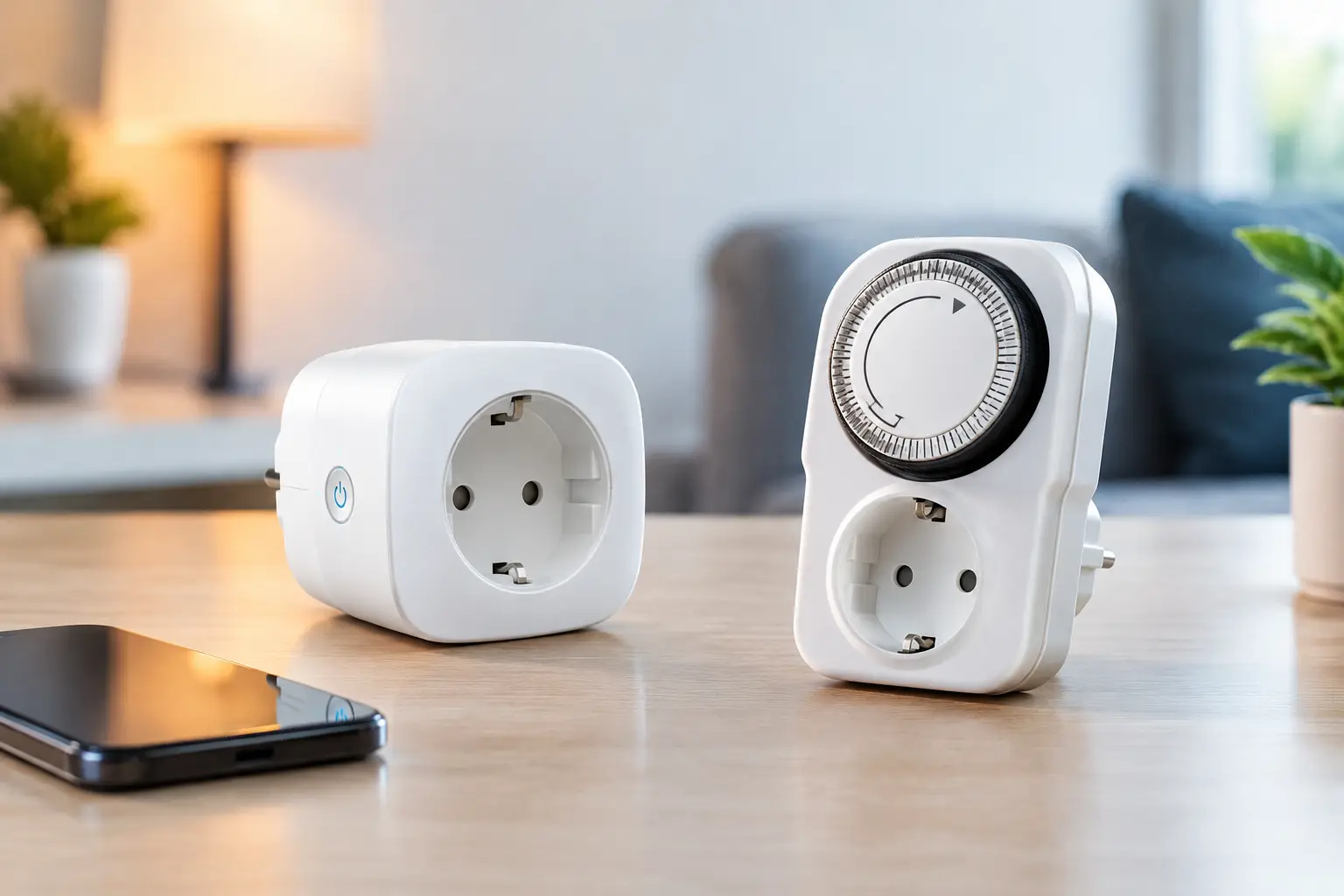
A mechanical timer connects to the electrical outlet, and the device connects to it. Turn a dial to the current time and press or lift small tabs to set when there will be power supply. In most models it is possible to set regular daily cycles, usually in segments of 15 or 30 minutes. No need for an app, wireless network or complex settings.
A smart plug works at the same starting point - it controls the flow of electricity to the device connected to it - but allows you to configure the control in the application. In most cases, it is possible to set on and off hours, create a countdown, activate remotely, and sometimes monitor power consumption. Some models connect to voice assistants or work according to conditions, for example turning on a lamp at sunset.
The main difference is not the actual timing, but the flexibility. A mechanical timer does one repetitive action. A smart plug allows you to change it in seconds, even when you are not at home.
Smart plug vs. mechanical timer: a quick comparison for the right purchase
Cost: The timer wins the initial outlay
A basic mechanical timer usually costs less. It is a good choice when you need a few simple units for the home, for example for balcony lighting, a night lamp or lighting designed to create the feeling that someone is home while on vacation.
A smart plug often costs more, especially if it includes consumption metering or compatibility with a smart home system. And yet, this does not necessarily mean that it is less profitable. One plug that replaces a few inefficient habits - like a fan that stays on for hours or a desk lamp that runs unnecessarily - may restore some of the gap in comfort and control.
When comparing prices, don't just look at the discount. Check rating, number of orders, plug type, supported voltage and maximum power. An extremely low price does not compensate for a product that does not fit the Israeli outlet or does not withstand the load of the device.
Convenience: a smart device saves daily hassle
There is something very convenient about a mechanical timer: connect, turn, and it works. It does not depend on the Internet and does not require a user account. In the event of a power outage, many models simply continue to run according to the dial after the power is restored, although the time itself may be out of sync.
The disadvantage is revealed when a small change is needed. Do you want the lamp to turn on an hour later only on the weekend? You have to go to the timer and rearrange the tabs. If you forgot to turn off a device before leaving, you have no way to fix it remotely.
In the smart plug, the change is made from the phone. You can turn off a floor lamp from bed, turn on a device before you get home, or change the schedule according to the seasons. For those who already use the phone to manage tasks, this is a convenience that is felt very quickly.
Accuracy: depends on your need
Mechanical timers work according to fixed time intervals. If the model allows 30-minute segments, it is usually not possible to set on at 19:10 and off at 19:25. For lighting that needs to operate in the evening, it usually doesn't matter.
Smart plugs often give minute accuracy and sometimes even more complex scenarios. You can set a lamp to turn on at sunset, a scent diffuser to work only for an hour, or a table lamp to work only on certain days. This is especially useful when the home routine changes between workdays, weekends and vacations.
It is important to distinguish between accuracy and real need. There is no reason to pay more for complex automations if all you want is to turn off outdoor lighting at midnight every day.
Remote control: a clear advantage for the smart plug
This is the field where there is really no competition. A mechanical timer requires a physical presence near the outlet. A smart plug allows you to check the status and change it from anywhere, as long as it is connected to the wireless network and the application is available.
It is convenient for lamps, fans, aquarium lighting, humidifiers and chargers. Even in a home with elderly family members, it is sometimes possible to turn on or off a simple light without explaining how to turn a dial.
On the other hand, remote control depends on the network. If the router falls or the plug loses connection, some of the smart functions will not work as you planned. Therefore, for a device that requires completely constant operation and no dependence on the Internet, a mechanical timer can still be a more relaxed choice.
In what uses is each solution more suitable?
For ambient lighting, a night lamp or balcony lighting with fixed hours, a mechanical timer is an economical and simple solution. It is also suitable for those who do not want an additional application or mess with network settings.
A smart plug is more suitable for a living room lamp, fan, humidifier, home grow lighting or a device that you want to turn on according to changing hours. If you leave the house often, go on vacations or simply forget to turn things off, it gives a clearer value.
For holiday lighting or seasonal decorations, both solutions are good. The timer is enough if the hours are fixed. A smart plug is better if you want to change the activation according to the days, activate only when you are at home or use the effect of presence while traveling.
Before buying: tests you shouldn't skip
Not every plug is suitable for every device. Before adding to cart, check the following four things:
- Socket type and device: Make sure the plug fits the Israeli socket and the voltage is 230 volts. Product images can be misleading, so look for clear specifications.
- Maximum power and current: Check how many watts or amperes the product supports, and compare to the data of the device you will connect. A high load device requires a more suitable solution, not a random cheap plug.
- Quality and safety: Prefer a model with a good rating, many orders and reviews that mention real use over time. Abnormal heating, thin plastic or a loose connection are warning signs.
- Features you'll actually use: Power metering, voice control and sunset timing sound great, but there's no point paying for them if you don't use them.
There are also devices that should not be connected to a smart plug or a regular timer without understanding the load and installation. Ovens, heat diffusers, air conditioners, cooking appliances and high-power appliances may require a dedicated outlet or a professional electrical solution. In an electric boiler, for example, in many cases the right solution is a dedicated smart switch that is installed by a qualified electrician, and not a plug that connects to an outlet.
When should you not upgrade to a smart plug?
If you need to turn it on and off at the same times every day, there is no reason to turn a simple task into a project. A reliable, cheap mechanical timer that does not require a network connection and does not create a dependency on the application. It is also a convenient solution for a rented apartment or for temporary use.
A smart plug pays off when it has a role beyond basic scheduling: remote control, variable schedule, automations or consumption tracking. It doesn't have to be in every socket in the house. A good start is to choose one device that bothers you on a daily basis and check if the smart control really changes the routine.
In the catalogs of smart home products, you should filter by rating, number of orders, supplier and compatibility with the local outlet, instead of choosing only by the discount percentage. In Smart Home Finds Deals you can use this filter to narrow the search and identify models that seem relevant before checking the full specifications.
The smart choice is not always the smartest product. Choose a mechanical timer when you need a permanent, simple and cheap solution; Choose a smart plug when the remote control will save you real hassle. That way every outlet in the house will work a little more according to your life, and not the other way around.