
July 26, 2026
7 viral new products for the kitchen that are worth a place
Looking for new viral products for the kitchen? This way you will identify useful gadgets at a good price, compare ratings and orders, and avoid unnecessary buying of passing trends for the home and daily cooking.
The video looks familiar: a small tool cuts, filters, froths or organizes the kitchen in a few seconds, and the price is low enough to click buy without thinking. But new viral kitchen products don't always make cooking easier. Some of them solve a real everyday problem, and some just look good in front of a camera before they take up space in a drawer.
The smart way to buy is not to chase every trend, but to check if the product saves time, dirt, space or frustration in an operation that repeats itself at your home. When the price is low, it's easy to be tempted, but even a small purchase that you don't use isn't really a deal. Here's how to choose trendy kitchen gadgets that justify the price and storage space.
Why are kitchen products becoming viral?
The kitchen produces many short and annoying operations: peeling garlic, straining pasta, cutting vegetables, keeping leftovers or cleaning a surface after preparation. A product that presents a clear solution to one of them works great in a short video. The viewer sees a problem, sees one simple action, and immediately imagines himself using it.
But Virality does not test durability, quality of materials or ease of cleaning. It also does not reveal whether the dish is suitable for the amount of food you prepare, for the drawers in your house or for your dishwasher. That's why you should treat the video as an inspiration to discover a product, not as proof that it's a good buy.
New viral kitchen products worth checking out
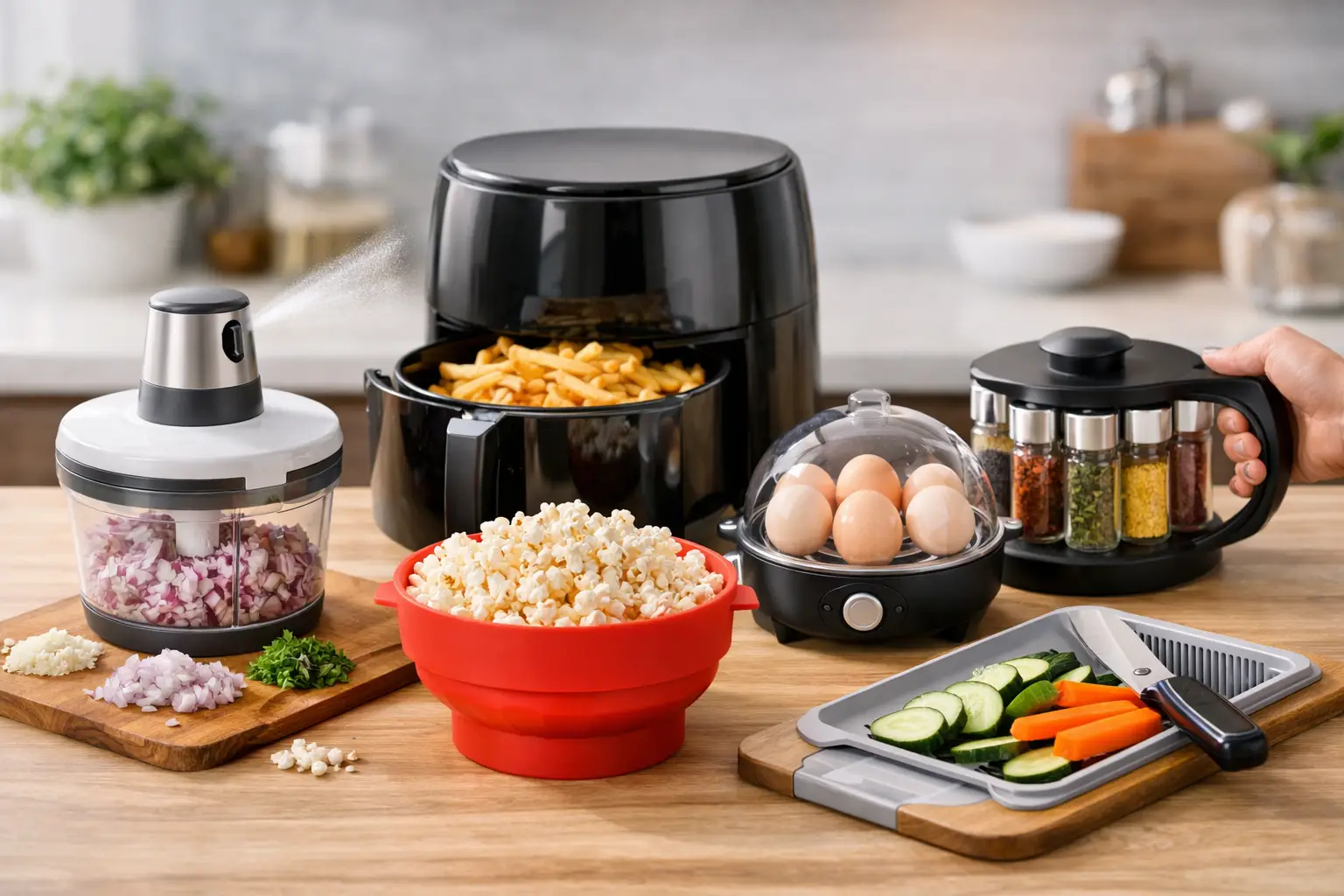
Manual vegetable chopper with collection box
Manual choppers with interchangeable blades continue to be popular because they give a relatively uniform result without taking out a food processor. They are especially useful for salads, onions, cucumbers, potatoes and vegetables for quick midweek preparation. The collection box reduces dirt on the counter, which is the real advantage over just a knife and board.
The downside is the cleaning. If the blades are crowded or the plastic is thin, food residues get stuck and make the tool less convenient than it seems. Check that there is a cleaning brush, that the box closes well and that the dimensions correspond to the amount you usually cut. For a family that makes a lot of salads, a large and stable model is better than a cheap and too small product.
Clip strainer for the pot
This is one of the simple inventions that can really save an extra dish in the sink. The strainer attaches to the rim of the pot and allows you to pour water from pasta, potatoes or cooked vegetables without transferring everything to a separate strainer. It is especially suitable for small kitchens and for those who prefer fewer dishes to wash.
Here fit is everything. Not every clip sits well on thick pots, on pots with a wide rim or on pans. You should look for review photos that show the product on different types of pots, and check the size range instead of relying only on the title. Heat-resistant silicone is also more important than flashy color or an unusual design.
Anti-slip silicone cover
Flat silicone lids that are placed on a pot while boiling are designed to reduce overflow of water, milk or sauces. It's a product that doesn't promise magic, but can prevent one of the most common kitchen mistakes. It is also sometimes used as a microwave lid or to cover bowls, so its use does not end only on the stove.
It is not a substitute for supervision over a boiling pot, especially when cooking at high intensity. Choose a diameter that fits your common pots, and check that the product is specified as suitable for contact with food and high heat. If you cook mainly in small pots, a lid that is too big will be cumbersome and will not save anything.
A tool for washing and filtering rice and grains
Filter bowls with fine holes or special strainers for rice get a lot of attention because they solve a small and familiar problem: rice grains spilling into the sink. They are also convenient for washing quinoa, lentils, small fruits and herbs, so they can be more useful than a tool with only one function.
You should prefer holes small enough to prevent grains from escaping, but not so small that cleaning becomes a chore. A bowl with a stable base and a comfortable grip will serve you better than a folding model that looks smart in the picture but bends during use.
Modular storage containers for the pantry
Clear containers for cereal, flour, pasta, and snacks aren't exactly a new gadget, but modular models with a pour spout, stickers, and an airtight seal have become a regular viral product. They make order, make it easier to see what's missing and make it possible to use shelves more efficiently. For those who shop in bulk or keep a stocked pantry, this is a very practical upgrade.
You don't have to replace the entire pantry at once. Start with three or four products that you use the most, such as rice, coffee, cornflakes and flour. This way you will check if the opening is comfortable, if the sealing is good and if the measurements really fit your closet before ordering a large set.
Sponge holders and drying facilities for the sink
Small sink accessories are among the cheapest purchases with the most immediate impact. A hanging sponge holder, a soap dispenser with a draining tray or a collapsible drying surface can reduce dampness, odor and mess in an all-day work area. The advantage is not only a neat appearance, but also the possibility to let the sponge dry between uses.
Pay attention to the type of sink and the location of the faucet. A holder designed for a round faucet will not necessarily fit a square or thick faucet, and a large fixture may interfere with washing dishes. A short measurement before buying saves a return or a product left in the package.
Digital food thermometer
Of all the viral products, a food thermometer is perhaps the least flashy and most useful. It helps to reach an accurate degree of doneness in the meat, check oil for frying, verify the temperature of baked goods and reduce guesswork. For those who cook chicken, steaks or baked goods regularly, this is a small tool with real value.
Check the reading time, temperature range, battery type and needle length. A folding model is convenient for storage, but even a simple model can be sufficient if the screen is readable and the measurement is consistent. There's no need to pay more just for colored lighting or an app, unless you really plan to use them.
How to spot a good deal before ordering
Sale price is just a starting point. To make the right choice, look at the full picture: rating, number of orders, reviews with photos and size specifications. A product with thousands of orders and a consistent rating usually gives a more reliable image than a new product with only a perfect advertising image.
You should also ask four short questions before adding to the basket:
- Does it solve an action I do at least once a week?
- Can it be easily cleaned after normal use?
- Do I have a permanent place to store it?
- Does it fit the dimensions of the pots, sink, cabinets or appliances I already have?
If the answer to two or more of the questions is no, the trend is probably not right for you right now. On the other hand, a simple product that meets a recurring need can be worth much more than any expensive gadget that promises a smart kitchen.
This is how you compare similar products without wasting time
When there are dozens of versions of the same tool, don't automatically choose the lowest price. Compare the material, dimensions, amount of included accessories and buyer ratings first. Thick plastic, high-quality silicone or stainless steel can justify a small difference in price if they extend the life of the product and make cleaning easier.
It is especially important to read one to three star reviews. There you will find the recurring problems: a lid that does not seal, a handle that breaks, a vessel that is smaller than expected or a color that is different from the picture. Positive reviews explain why people liked a product, but disappointed reviews show whether the problem is relevant to your use.
In an organized catalog like Smart Home Finds Deals, you can sort by category, discount, rating and orders instead of opening dozens of similar lists. It shortens the way between a viral video and a basic check of what really sells, what gets good responses and what fits your budget.
When is it better to give up on a kitchen trend?
Discard a product if it replaces a tool that already does the same job well, if it requires more complex cleaning than the operation it saves, or if it is intended for very infrequent use. Products with many small parts, delicate mechanisms or exaggerated promises also deserve a double check.
There is a difference between a tool that shortens the preparation of a meal every day and an accessory that is only intended for a beautiful photo. The goal is not to turn the kitchen into a gadget warehouse, but to build a small collection of products that work for you. The next time a viral kitchen product pops up in your feed, pause, check measurements and reviews, then let everyday use—not five-second enthusiasm—decide whether it deserves a place in your kitchen.